At a Glance
Best For
Overview
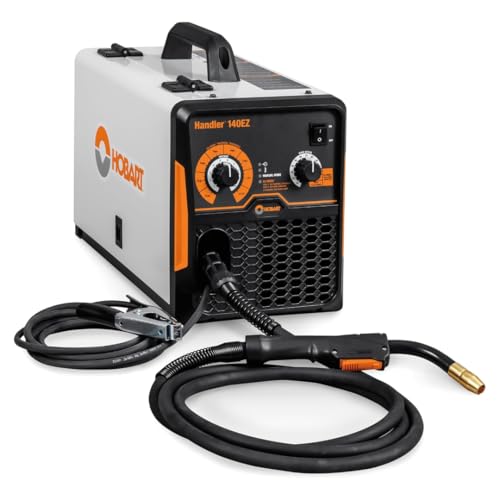
The Hobart Handler 140 has been the default 'first MIG welder' recommendation on welding forums for over 15 years. It's the machine that gets named when someone posts 'I want to learn MIG, what should I buy?' on r/welding, in YouTube comment sections, on garage journal threads — the same answer comes back: Handler 140. At $489 it's not the cheapest entry into MIG (you can get a Lotos MIG140 for $299 or a Forney Easy Weld 140 for $349), but it's the cheapest one that does the job right.
What 'does the job right' means for the Handler 140 comes down to one thing — wire feed consistency. The drive system, the tension mechanism, the gun liner, the entire wire-handling path is engineered to feed smoothly across the full range of speed settings. Cheaper machines stutter at low speeds and overrun at high speeds. The Handler 140 doesn't. That single quality difference is why it has the cult following.
The trade-off is 115V-only input, which is the most-cited limitation. The Handler 140 cannot step up to 230V to push more amperage. If you outgrow 140A, you're buying a new welder. The Miller-owned Hobart brand sells the Handler 210 MVP ($1,100) as the dual-voltage upgrade path, and many Handler 140 owners eventually make that jump. For the buyer starting out, 140A is enough for 95% of garage fabrication. The voltage limitation matters more in theory than practice for most first welders.
Pros & Cons
Pros
- 5 voltage settings give fine amperage control for thin gauge
- Excellent wire feed consistency — one of the best at this price
- Hobart/Miller family — strong dealer and parts network
- Runs on standard 115V household current
Cons
- 115V only — can't step up to 230V as shop grows
- 25% duty cycle at max output limits heavy work
- Slightly heavier than newer inverter-based competitors
Hobart Handler 140 MIG Welder
Prices may change · Free shipping with Prime
Five-Position Voltage Control — Why It Beats Infinite Adjustability
The Handler 140 has five voltage tap settings instead of a continuously variable dial. Cheaper machines often advertise 'infinite voltage control' as a feature, but in practice that means you spend more time twisting knobs trying to find the sweet spot. The Handler's discrete taps map to actual material thickness ranges — Position 1 for 24-gauge sheet, up through Position 5 for 1/4" plate. The wire-speed dial is the only continuous control, and Hobart's settings chart inside the door tells you the starting speed for each voltage tap on each wire size.
This matters most for new welders who don't yet have the intuition for matching heat to material. With five taps you can't be too far off — pick the closest tap to your material thickness, then dial in wire speed by ear (the sound of the arc tells you when you're right; a frying-bacon hiss means correct, a popping or sputter means wrong). After 20 hours of welding you stop reading the chart and start hearing the right settings.
A secondary benefit: the tap design simplifies the internal transformer. Fewer moving parts in the voltage control path means fewer failure points over 20+ years.
Wire Feed Consistency — The Hidden Quality Differential
Wire feed is the single most important quality variable on a budget MIG welder, and it's the one you can't see in a spec sheet. Three things make the Handler 140's feed system better than its competitors at this price: the dual-groove drive roller (handles both 0.023" and 0.030"/0.035" wire without slipping), the strong but adjustable wire-spool brake (prevents overrun without binding), and the high-quality copper-impregnated drive motor (consistent torque at all speeds).
The practical result: when you pull the trigger, wire comes out at the speed you dialed. Not a burst-then-slow at trigger-pull, not a stutter when you're welding around a corner and pulling the gun cable around something, not a birdnest in the drive when you stop. Just consistent feed.
For someone who's only welded with the cheap machines, the difference is hard to describe until you've used both back-to-back. The Lotos MIG140 will lay an acceptable bead. The Handler 140 lays a noticeably better one on the same joint, in the same conditions, with the same operator. The arc is simply more stable because the wire feed is more stable.
115V-Only Reality — Where It Hurts and Where It Doesn't
The Handler 140 runs on a standard household 115V/20A outlet. That's the entire input story — no 230V step-up, no dual voltage flexibility. For most home shops this is fine. A typical garage has 115V outlets everywhere and one might already be on a dedicated 20A circuit. Plug in, weld.
Where the 115V limit hurts: thicker materials need more amperage, and more amperage on 115V means more inrush current. The Handler 140 maxes at 140A, which is enough for 3/16" single-pass and 1/4" multi-pass. Anything thicker requires either multiple passes (slow, but works) or a beefier welder.
Where it doesn't hurt: 95% of garage fabrication, auto body work, lawn mower repair, trailer welding, fence work, decorative metal — all of this lives in the 18-gauge through 3/16" range where 140A is plenty. The limitation matters most for people who think they'll want to weld heavy structural steel someday. Those people should either skip to the Handler 210 MVP (210A, dual voltage, $1,100) or buy the Handler 140 and accept upgrading later. There's no in-between.
Hobart's Dealer and Parts Network — The Long-Term Value
Hobart is owned by Miller, which is owned by Illinois Tool Works. The same parts, service network, and warranty infrastructure that supports Miller machines supports Hobart. Every major welding supply distributor — Airgas, Praxair, regional welding suppliers — stocks Hobart consumables, drive rollers, contact tips, gun liners, and replacement parts.
The 5-year warranty on the Handler 140 is real. If the wire feed motor fails in year 3, you call Hobart, they ship a new motor or direct you to a service center. This is genuinely different from Chinese-brand budget welders where 'warranty' often means shipping the unit back to a single distribution center at your expense for unclear repair timelines.
Long-term, this is what justifies the $189 price premium over a Lotos MIG140. The Lotos will probably last 5–8 years of hobby use. The Hobart will run for 15–25. Service availability throughout that life is night-and-day different. Buy a Handler 140 expecting it to be the welder you teach your kids to weld with.
Hobart Handler 140 vs Lincoln Easy MIG 140
Both are entry-tier 115V MIGs from established American brands. Both target the same buyer. Both will last 15+ years with reasonable care. The differences are subtle:
Lincoln Easy MIG 140 ($599): slightly higher price, slightly fancier electronics with digital display option, smoother arc on aluminum spool gun work, slightly easier setup chart inside the door. Lincoln's dealer network is comparable to Hobart's.
Hobart Handler 140 ($489): $110 cheaper, simpler all-mechanical voltage tap system (more durable long-term, fewer electronics to fail), better wire feed consistency at the very low end (matters for auto body and thin sheet work), wider availability at hardware-store-level retailers like Tractor Supply.
For most buyers the Hobart wins on value. If you specifically want Lincoln's color/digital display or you're already invested in Lincoln's MIG accessory ecosystem, the Easy MIG 140 is a defensible choice. Either machine is a long-term keeper.
Our Verdict
The Handler 140 is the classic recommendation for first-time MIG welders, and it earns that reputation every year. Consistent wire feed, reliable 5-position voltage control, and Hobart's support network make it a safe first investment. The 115V-only limitation matters if you plan to upgrade welding capacity.
Hobart Handler 140 MIG Welder
$489
Prices may change · Free shipping with Prime
| Full Specifications | |
|---|---|
| Process | MIG / Flux-Core |
| Amp Range | 25–140A |
| Max Amps | 140A |
| Duty Cycle | 25% @ 90A |
| Input Voltage | 115V |
| Wire/Rod Gauge | 0.023–0.035 in solid; 0.030–0.035 in flux-core |
| Max Metal Thickness | 3/16 in |
| Weight | 57lbs |
| Auto-Set | No |
| Spool Gun Ready | No |
| Warranty | 5yr |
| Brand | Hobart |
Frequently Asked Questions
Do I need a 220V outlet to run the Hobart Handler 140?
How thick of metal can the Hobart Handler 140 weld?
Does the Handler 140 work with aluminum?
Is the Hobart Handler 140 still the best beginner MIG welder in 2026?
Related Buying Guides
Compare With Similar Welders
Lincoln Electric
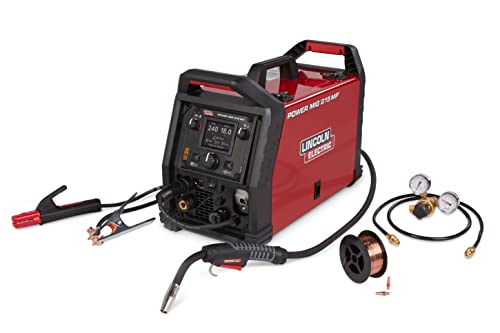
Power MIG 210 MP
MIG / TIG / Stick / Flux-Core · 210 A · 40% @ 150A
$949
Head-to-Head Comparisons
Hobart Handler 140 MIG Welder
$489
Prices may change · Free shipping with Prime