At a Glance
Best For
Overview
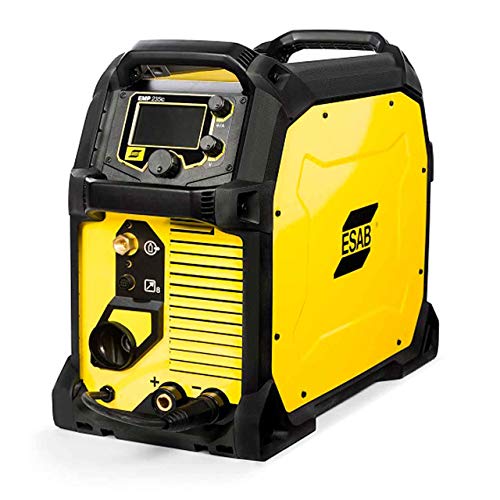
The ESAB Rebel EMP 235ic is the professional-tier multi-process welder for home shops and small commercial operations. At $1,299 it sits above the Lincoln Power MIG 210 MP ($949) and below the Miller Multimatic 220 AC/DC ($3,500). What you get for the price is a machine built to ESAB's industrial standards — the company that makes welders for shipyards, refineries, and pipelines — scaled down to a 49-lb portable.
The headline feature is sMIG, ESAB's adaptive MIG technology. The machine reads the actual arc characteristics in real time and adjusts voltage and wire speed continuously to maintain the cleanest possible bead. For beginners this means visibly better welds while you're still learning. For experienced welders it means less manual tuning when switching between materials or thicknesses. sMIG is the closest thing in the welding world to 'auto-tune for your bead.'
The Rebel's other distinguishing trait is its universal input voltage — it runs on anything from 120V single-phase up to 240V single-phase without configuration. Like Miller's Auto-Line, this matters for welders who work in multiple locations or on inconsistent power. Unlike many multi-process machines, the Rebel's DC TIG is genuinely refined — scratch-start with smooth low-amp control suitable for stainless food-grade work. The notable absence is AC TIG, which means no aluminum TIG. ESAB sells the Rebel EMP 215ic (AC/DC version) at higher cost for aluminum-focused buyers.
Pros & Cons
Pros
- sMIG adaptive technology auto-adjusts parameters mid-bead
- True DC TIG with scratch start — excellent for stainless and mild steel
- Runs on any input 120V–240V single phase — genuinely universal
- Color display with intuitive job memory
Cons
- Premium price — $1,299 is serious money
- No AC TIG — can't weld aluminum via TIG (spool gun MIG for aluminum)
- Heavier than basic inverters at 49 lbs
ESAB Rebel EMP 235ic Multi-Process Welder
Prices may change · Free shipping with Prime
sMIG Adaptive Technology — What It Actually Does
sMIG (Smart MIG) is ESAB's marketing name for an adaptive arc control system. The machine samples the arc voltage, current, and short-circuit behavior at very high frequency (multiple kHz) and continuously adjusts the output parameters to maintain optimal arc characteristics. In simpler terms: the machine watches what your bead is doing and tunes itself to make it better.
For a beginner welding mild steel for the first time, this means the difference between an ugly, spatter-heavy bead and a smooth, consistent one — with the same operator technique. The sMIG system absorbs minor errors in gun angle, travel speed, and stand-off distance. You can still weld badly with sMIG (the machine can't fix major operator errors), but the floor of weld quality is meaningfully higher.
For an experienced welder, sMIG matters most when switching between materials. Moving from 16-gauge sheet to 3/16" plate normally requires re-tuning voltage and wire speed manually. With sMIG you change the wire-size and material-thickness inputs on the LCD, and the machine handles the rest. Production shops save real time on setup transitions.
The trade-off: experienced welders sometimes prefer manual control over what the machine is doing. sMIG can be turned off, leaving conventional CV (constant voltage) MIG. Both modes coexist on the same machine.
DC TIG — Refined for Mild Steel and Stainless
The Rebel's DC TIG is the best TIG implementation in any multi-process machine under $2,000. Lift-start (you touch the tungsten to the workpiece, then lift to strike the arc) is smooth and contamination-resistant. Amperage range is 5–235A with precise control across the low end where stainless and thin material welding lives.
The TIG arc is stable down to 5A, which is genuinely useful for fine work — welding stainless steel exhaust tubing, thin-wall stainless tanks for food and beverage work, jewelry-scale stainless fabrication. Most multi-process machines lose arc stability below 15–20A, making fine TIG work impossible without buying a dedicated TIG machine.
Foot pedal control is optional (sold separately) and works well. With the pedal you control amperage in real time as you weld, which is the standard professional TIG workflow. Without the pedal you set amperage on the panel and weld at fixed output, which is fine for production welds at consistent thickness but limiting for variable-thickness work.
The absence of AC TIG (no aluminum TIG) is the main TIG limitation. If aluminum TIG is your primary use case, the Rebel EMP 215ic AC/DC version exists at higher cost ($1,799). For mild steel and stainless TIG work, the Rebel EMP 235ic is the right machine.
60% Duty Cycle at 185A — Real Production Capability
60% duty cycle at 185A is genuinely industrial. It means: in any 10-minute window, you can weld at 185 amps for 6 minutes before thermal protection kicks in. For comparison, the Lincoln Power MIG 210 MP runs 40% at 150A; the Hobart Handler 210 MVP runs 30% at 150A. The Rebel is in a different duty cycle tier.
For production work — long structural welds, trailer manufacturing, repetitive fabrication on the same setup — this duty cycle prevents the start-stop interruptions that plague lower-tier machines on heavy work. You can weld continuously through a job without waiting for the machine to cool.
For hobby work this is overkill. Most garage welders never push duty cycle to its limits because individual welds are short and the machine cools between passes. But the duty cycle headroom is one of the things justifying the Rebel's $1,299 price — you're not just buying capability, you're buying capacity. A machine that can run hot continuously is a machine that will outlast one that can't.
Build Quality and the ESAB Warranty
The Rebel's case is impact-resistant polymer over an aluminum chassis. ESAB designed it for mobile work — pipeline welders, mobile mechanics, field repair crews — where the machine takes real abuse. Bumpers protect the corners. The carry handle is steel and bolted through the chassis (not screwed into plastic). The control panel is recessed and protected.
The wire feed mechanism is industrial-grade. ESAB uses a metal drive system with multiple drive rollers and the same wire path architecture as their commercial production welders. Wire feed consistency is comparable to the best machines in the multi-process category — Miller Multimatic 220 AC/DC level, at half the price.
Warranty is 3 years on the inverter and 1 year on the wire feed system. ESAB's service infrastructure in North America is smaller than Miller's or Lincoln's but exists in major metro areas. The Rebel is the kind of welder that doesn't generally need warranty service in its first decade of use — the build quality means failures are rare.
ESAB Rebel EMP 235ic vs Lincoln Power MIG 210 MP
The two machines target similar buyers but at different price points. The Lincoln Power MIG 210 MP at $949 is the value play; the ESAB Rebel EMP 235ic at $1,299 is the premium play. The $350 difference buys:
Better MIG arc (sMIG adaptive control vs Lincoln's manual CV MIG), better TIG capability (Rebel's smooth lift-start with 5A low end vs Lincoln's basic lift-start with 15A practical low end), higher duty cycle (60% at 185A vs Lincoln's 40% at 150A), industrial-grade build quality vs commercial-grade build quality, and ESAB's professional service infrastructure vs Lincoln's broader but more consumer-oriented network.
What the Lincoln offers that the Rebel doesn't: better aluminum MIG capability via the Lincoln Magnum 100SG spool gun (the Rebel supports a spool gun too but it's a separate purchase), broader retailer availability (Lincoln products are at Home Depot, Tractor Supply, every welding supply), and lower upfront cost.
For a hobby welder who'll use the machine 5–10 hours a week on varied projects, the Lincoln is the smarter buy. For a serious welder who'll use the machine 20+ hours a week, professionally or semi-professionally, the Rebel's build quality and duty cycle make the $350 premium pay back quickly. For commercial production work, neither is appropriate — that's the Miller Multimatic 220 AC/DC tier ($3,500).
Our Verdict
The ESAB Rebel EMP 235ic is the benchmark professional-grade multi-process machine for serious home shops and small commercial operations. The sMIG adaptive arc is genuinely different — beginners get better beads automatically. If budget allows, this is the machine you keep for life.
ESAB Rebel EMP 235ic Multi-Process Welder
$1299
Prices may change · Free shipping with Prime
| Full Specifications | |
|---|---|
| Process | MIG / TIG / Stick / Flux-Core |
| Amp Range | 15–235A |
| Max Amps | 235A |
| Duty Cycle | 60% @ 185A |
| Input Voltage | 120V–240V universal |
| Wire/Rod Gauge | 0.023–0.045 in solid; 0.030–0.045 in flux-core |
| Max Metal Thickness | 1/2 in |
| Weight | 49lbs |
| Auto-Set | Yes |
| Spool Gun Ready | Yes |
| Warranty | 3yr |
| Brand | ESAB |
Frequently Asked Questions
Can the ESAB Rebel EMP 235ic weld aluminum?
What does sMIG technology actually do for me?
Is the Rebel EMP 235ic worth $350 more than the Lincoln 210 MP?
Does the universal input voltage really work on any outlet?
Related Buying Guides
Head-to-Head Comparisons
ESAB Rebel EMP 235ic Multi-Process Welder
$1299
Prices may change · Free shipping with Prime